In short-term rentals, three variables drive nightly rates. Location. Amenities. Square footage. The math of yield is the math of those three.
Palm Springs adds a fourth.
A documented architect — verified provenance attached to a specific name in the Desert Modernist canon — operates as an independent pricing lever. Two physically comparable homes in the same neighborhood, with the same square footage and amenity package, can clear at meaningfully different rates if one carries a name and the other doesn’t. The premium is not a feature of the building. It’s a feature of the attribution attached to it.
The structure that makes this work — and the conditions an asset has to meet to capture it — is the most interesting acquisition signal in the market.
The canon
The Desert Modernist movement produced a small, well-documented group of architects whose work in Palm Springs is now canonical. Six names recur across architectural guides, museum exhibitions, and Modernism Week tour catalogs: William Krisel, Donald Wexler, Albert Frey, Richard Neutra, William Cody, and E. Stewart Williams.
The reasons each carries weight differ, and that difference matters.
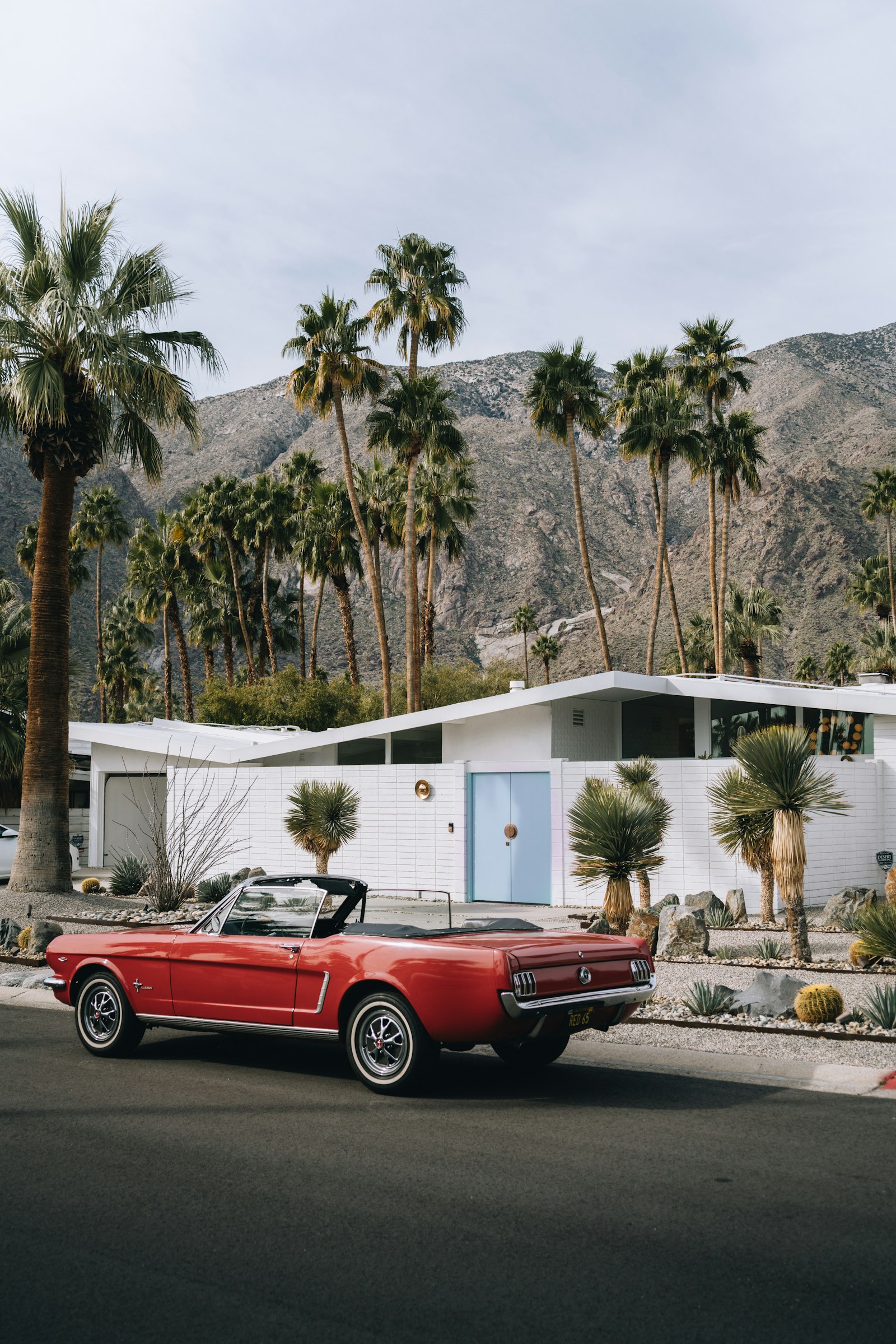
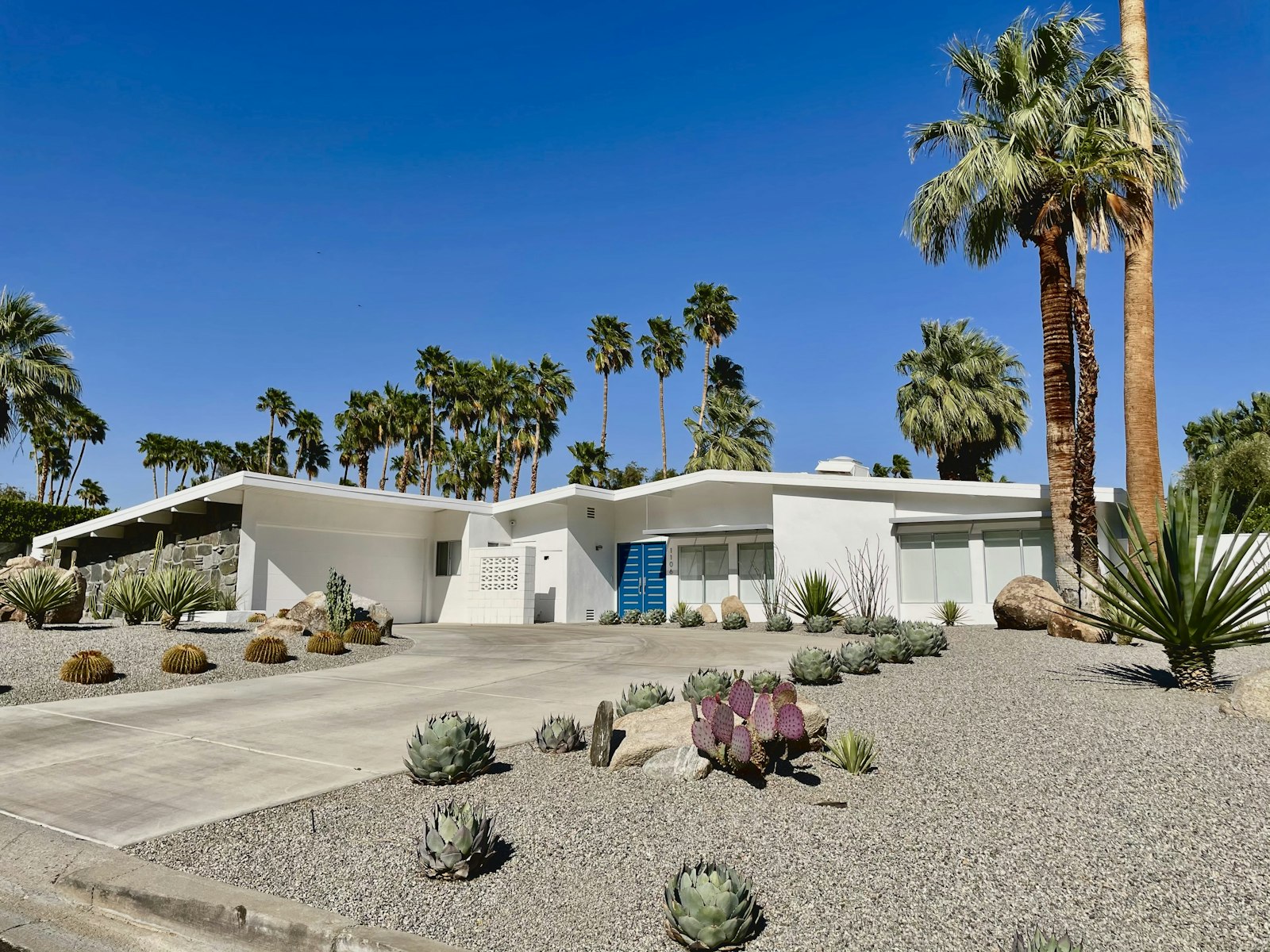
The Alexander Construction Company built more than 2,200 homes across the Coachella Valley between 1955 and 1965, the majority designed by Palmer & Krisel. Roughly 1,200 of those homes sit in Palm Springs proper, distributed across neighborhoods that have become destinations: Twin Palms Estates (90 homes), Racquet Club Estates (360 homes), Vista Las Palmas (330 homes), Sunmor Estates, and the Las Palmas Estates above downtown. These are finite tracts. Recognizable architectural language. Neighborhoods that draw architecture-literate guests on their own terms. Beyond the Alexander tracts, Krisel’s Kings Point — 44 detached homes near Indian Canyons, designed by Krisel for developer Bob Grundt between 1968 and 1970 — represents his later, more refined International Modern work.
Wexler’s signature is the Steel Development Houses, designed with Richard Harrison in 1960 for the Alexander Construction Company. Only seven were ever completed before steel prices killed the program. All seven now carry Class 1 Historic Site designation from the City of Palm Springs. A Wexler steel home is one of seven — the scarcity is not narrative, it’s literal. Wexler also designed for Alexander outside the steel program (Green Fairway Estates) and earlier in his career partnered with Richard Harrison on the original eleven Higgins-built homes in Sunmor.
Frey’s premium concentrates in fewer surviving structures. Frey House II, his personal home integrated into a mountain boulder above the city, is owned by the Palm Springs Art Museum and not rentable. The Frey premium that reaches the rental market reaches it indirectly, through proximity and through a small handful of other Frey-attributed residential work.
Neutra’s Palm Springs presence is concentrated in a single house. The Kaufmann Desert House, built in 1946, sold for $13 million in 2022 — a record for the Palm Springs market. It is not a rental property. It is the ceiling that tells the rest of the canon what its premium ought to look like.
Cody and Williams round out the recognized roster. Cody for hospitality and country club work, including the Del Marcos Hotel and L’Horizon. Williams for the Frank Sinatra Twin Palms estate, with its piano-shaped pool, and the first phase of the Palm Springs Art Museum.
Six names. Concentrated body of work. Documented provenance available to anyone willing to look up the property.
What provenance actually does to a listing
The mechanism of the premium is worth being precise about, because it isn’t what most owners assume.
Provenance does not make a property a better stay. A 1957 Krisel-designed Twin Palms home is roughly 1,600 square feet, originally built without insulation, on a slab, with single-pane glass. Krisel didn’t design it to be a high-end rental. He designed it to be an affordable second home for the postwar middle class. A renovated version of that house can be a beautiful place to stay — but the renovation is what makes it beautiful, not the architect.
What provenance does is reframe the listing.
A renovated three-bedroom mid-century modern home in Vista Las Palmas at 2,100 square feet can be marketed as “a mid-century modern home in Vista Las Palmas.” Or it can be marketed as “a 1961 Alexander home designed by William Krisel in Vista Las Palmas.” The second listing draws a different guest — the architecture-literate guest, the Modernism Week attendee, the design-magazine reader, the guest who came to Palm Springs specifically because of what the city is rather than because of what their hotel happens to be. That guest pays more for the same physical experience because the listing is selling a different product.
The first listing is selling a stay. The second is selling proximity to a documented work.
This is closer to art-market economics than to real-estate economics. The premium isn’t proportional to the cost of the building or the quality of the renovation. It’s proportional to the certainty of the attribution. A signed Krisel with documented provenance carries a different price than an unsigned mid-century home in the same neighborhood, the same way a signed work carries a different price than an attributed one in any other authentication-driven market.
The authentication infrastructure
Palm Springs can sustain this kind of premium where other markets cannot because the city has built formal infrastructure to authenticate provenance.
The Palm Springs Preservation Foundation maintains records of attributed works. The City of Palm Springs maintains a Class 1 Historic Site designation granted on architectural significance — Wexler’s Steel Houses, the Kaufmann House, the Tramway Gas Station, Frey House II, City National Bank, Town & Country Center, and a growing list of others all carry it. Class 1 status comes with Mills Act tax savings as a financial benefit, and with something more valuable for the rental market: third-party validation that a property is what its listing says it is.
Modernism Week’s neighborhood tours operate as a parallel authentication layer. A home opened to the public during a tour is documented in the festival catalog, photographed in trade publications, and absorbed into the city’s broader architectural record. The festival is one of several anchors in the Palm Springs calendar that benefits provenance-documented properties — its yield-window dynamics are covered in The Festival Calendar Distortion.
The infrastructure means a guest can verify the claim in a Google search before booking. Architectural premium narratives in other markets fall apart at this step. In Palm Springs, the verification adds weight rather than removing it.
The acquisition signal
The acquisition implication is specific.
A property without documented provenance, however beautiful, is priced on the same fundamentals as any other Palm Springs short-term rental — location, amenities, square footage, neighborhood positioning. A property with documented provenance is priced on those fundamentals plus an architectural premium captured by guests paying for narrative weight. The yield gap analyzed in The Yield Gap compounds in this market because architectural provenance is one of the cleanest ways to push a listing into the top decile that captures disproportionate festival-window revenue.
The acquisition question is binary. Is the architect documented through a verifiable record — Preservation Foundation, original construction permit, published architectural inventory? Is the structural integrity intact enough that the architect’s intent reads in the building, or has decades of renovation buried the bones?
A property that answers both questions affirmatively is a different asset class than a comparable property without that lineage. The premium is real, durable, and authenticatable.
A property whose attribution rests on neighborhood proximity rather than direct documentation sits in a fuzzier middle. It can market the aesthetic without claiming the provenance, but the premium it captures is a design-aesthetic premium, not an authenticated-architect premium. The two are often confused. They should not be.
One additional acquisition note worth flagging: not every neighborhood inside the canon permits short-term rental use. Kings Point, for example, has a 30-day rental minimum that takes it out of conventional short-term rental scope despite its Krisel provenance. The provenance question and the operational-use question should be answered together, not in sequence.
For existing owners
Most Palm Springs property owners have never run a formal provenance check on their own home. For any pre-1975 Palm Springs property, the question is worth answering. A search of Palm Springs Preservation Foundation records, original construction permits, and the inventory of Alexander Construction Company tract neighborhoods will resolve most cases quickly.
A home that turns out to be attributable Krisel, Wexler, Cody, or other canonical work has a listing premium available to it that current marketing language is probably not capturing.
The premium has three documentation requirements once attribution is confirmed. Verifiable sourcing of the attribution itself, not just listing-agent assertion. Photography that emphasizes the architectural elements that made the home significant — butterfly rooflines, clerestory windows, post-and-beam construction, breezeways, indoor-outdoor flow. And listing copy that names the architect, the year, and the neighborhood’s place in the Alexander or Desert Modernist catalog. Architecture-literate guests read listings closely. Generic “stylish mid-century vibe” language signals to that guest that the listing is not what it claims to be.
The premium narrows outside Modernism Week. It does not disappear. Architecture-literate guests travel to Palm Springs year-round.
The structural point
Palm Springs is a market where narrative is a measurable pricing input. The reason has nothing to do with brand or marketing. It has to do with the unusual concentration of canonical mid-century modern work in a small geographic footprint, the formal infrastructure the city has built to authenticate that work, and the existence of a guest segment that travels specifically to experience it.
The architectural premium is one of the few short-term rental pricing levers that compounds rather than depreciates. Location commands diminish over time as new neighborhoods come online. Amenity packages get matched and exceeded by newer construction. Square footage doesn’t move. Provenance, by contrast, becomes more valuable as the surviving stock thins, the architects’ historical reputations consolidate, and the canon itself ossifies.
The mid-century premium is not a marketing feature.
It is an asset class.
Virestia manages short-term rental properties in Palm Springs, Tulum, Houston, Miami, and Los Cabos. Direct-booking operations, market-specific pricing discipline, and full ownership of the guest experience.