Palm Springs runs on a calendar most pro formas don’t price correctly.
The market’s annual yield curve has a shape no other major short-term rental market shares. Five anchor events in a roughly ten-week window between February and late April. A summer that empties the city. A fall that recovers slowly. The math of owning here is the math of those ten weeks — and the math of those ten weeks is not what a smoothed annual ADR suggests.
This is the underwriting failure that defines the market.
The concentration
The Coachella Valley hosts five anchor events in spring. Modernism Week opens the calendar with eleven days of architecture tours from February 12 to 22. The BNP Paribas Open follows from March 1 to 15 — fifteen days of tennis at Indian Wells, the most-attended tournament outside the four Grand Slams, drawing more than 493,000 spectators in 2024. Coachella runs across two consecutive weekends in April, April 10-12 and April 17-19. Stagecoach closes the spring window April 24-26.
For Indio — the market closest to the polo grounds — three of those weekends capture roughly 70% of April’s total revenue according to AirROI’s 2026 pacing analysis. The shape is severe: asking ADRs run $560 to $640 through early May baseline, then jump to $1,260 on Friday April 17 — a 109% premium over the surrounding nights. AirROI’s data shows a single three-night Coachella stay can generate $3,600 in revenue. Roughly 5% of annual revenue earned in 0.8% of the year.
Palm Springs proper compresses that spread. The city’s 4,206 active listings and more diversified demand base produce a 32% Weekend 2 premium — meaningful, but softer than Indio’s. The shape of the curve is the same. A handful of weekends carry a disproportionate share of the year.
The implication runs deeper than peak pricing. A property modeled at a blended annual ADR misses both directions of the curve at once. The festival weeks earn far more than the average suggests. The off-season earns far less. An operator pricing the asset on a smoothed curve gives away the ceiling and absorbs the floor.
The 2024 inflection and the 2025 reversal
The festival premium is not unconditional. It rewards rate discipline and punishes its absence.
In 2023, Palm Springs short-term rental ADR for Coachella Weekend 1 averaged $580. By 2024, it had dropped to $523 — a 10% decline. RevPAR fell harder, from $418 to $321, a 23% drop. New supply that had flooded the valley between 2022 and 2024 met a guest base that had recalibrated its willingness to pay, and operators who had locked rates against 2023 expectations found themselves cutting prices into a softer demand curve.
The lesson would have been that the festival window was compressing. Then 2025 reversed it.
PriceLabs reported Indio Coachella Weekend 1 ADR rose 16% in 2025 over 2024, with RevPAR climbing 48%. Weekend 2 was sharper — a 22% ADR jump, a 67% RevPAR gain. Booked nights ran 27% above 2024 levels. The festival had not weakened. The pricing posture of 2024 had failed to match the actual demand curve, and operators who corrected for it captured a near-record year. AirROI’s 2026 booking data shows the average lead time for April stays in the Coachella Valley is now 104 days — significantly above the 68-day annual baseline — confirming that festival demand books well ahead of the standard short-term rental window.
The pattern is not that festival pricing power is fading. It’s that festival pricing power belongs to operators who calibrate to the actual demand curve, not the one they remember. The yield gap analyzed in The Yield Gap shows up in compressed form during festival windows. Top-decile properties capture a disproportionate share. The middle and bottom of the market absorb the cuts when conditions soften.
What the standard pro forma misses
Three assumptions embedded in most short-term rental underwriting models fail in Palm Springs.
Rate-window timing fails first. A typical short-term rental opens calendar 6 to 9 months in advance and adjusts dynamically as the booking window narrows. For Coachella, that timing is wrong in both directions. Lineup announcements drop in mid-September, tickets sell out within days, and the highest-intent guests lock travel within the first two weeks. Coachella 2026 sold out within a week of its September 2025 lineup announcement. AirROI’s 104-day average lead time for April stays confirms what the calendar dynamics suggest: the demand books significantly earlier than standard pricing models account for. An operator opening calendar in January for an April festival is pricing inventory after the highest-intent guests have already booked elsewhere.
Minimum-stay logic fails next. Festival weekends are three-night events with travel margin on either side. A two-night minimum gives away Thursday and Monday — nights guests would have paid for inside a four-night booking. A four-night minimum that runs Thursday through Monday captures the full demand surface. The difference between a $1,260 ADR on three nights and a $1,000 ADR on five nights is roughly $1,220 per booking, and the longer stay reduces turnover cost.
Event-layering logic fails third. Modernism Week and the BNP Paribas Open overlap with the existing snowbird high season. Underwriting models that flatten February and March into “high season” miss the documented premium that overlays it. Modernism Week’s eleven days draw collectors and design audiences willing to pay for proximity to the architecture being toured. Tennis Garden draws over 493,000 attendees across the BNP Paribas Open’s two weeks. A property in a featured Modernism Week neighborhood — Vista Las Palmas, Sunmor Estates, Deepwell, Racquet Club Estates — has a documented premium during the eleven-day festival window that exists nowhere else in the calendar.
The standard pro forma flattens all of this into an annual ADR and an annual occupancy. The flattening is the failure.
Architecture as event multiplier
Modernism Week creates a pricing dynamic specific to Palm Springs that doesn’t exist in any other major short-term rental market.
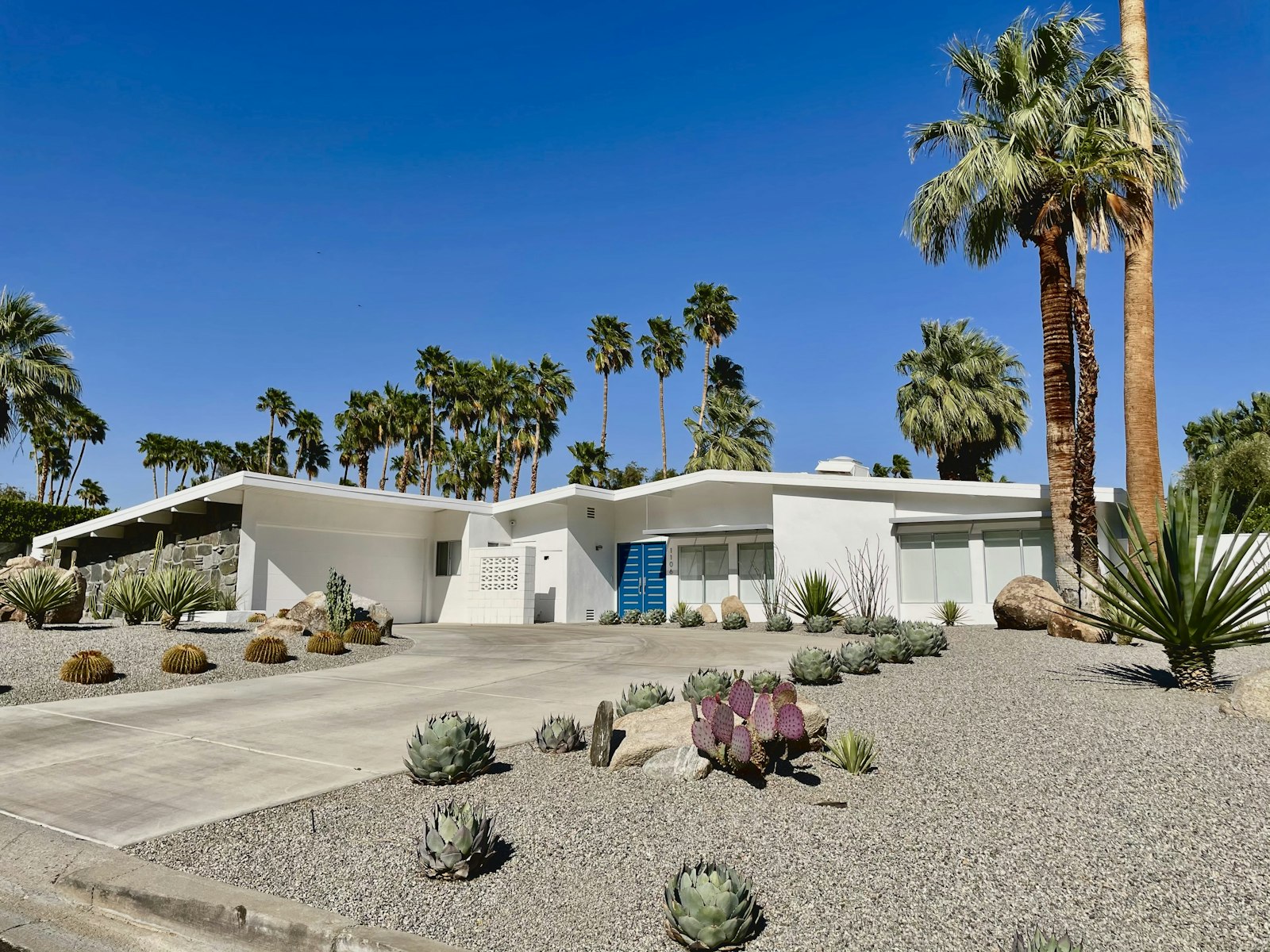
The festival’s signature programming is neighborhood home tours. Fifteen curated tours opened doors for the 2026 edition — Vista Las Palmas, Racquet Club Estates, Sunmor Estates, Country Club Estates, Canyon Estates, plus new additions in Andreas Hills, Casa Dorado at Indian Wells, and Firebird Estates. Properties inside or adjacent to those neighborhoods capture a demand layer that has nothing to do with the architecture of the rental itself and everything to do with proximity to the architecture being toured.
A William Krisel-designed Alexander home in Racquet Club Estates is priced as a cultural asset during Modernism Week. The same physical structure outside the festival window is priced as a vintage three-bedroom. The architectural premium isn’t a feature of the property. It’s a feature of the calendar — and only the calendar.
The deeper structural argument for why architectural provenance operates as an independent pricing lever in Palm Springs — and which architects’ work carries it — is covered in The Mid-Century Premium.
The underwriting reframe
The cleanest way to underwrite a Palm Springs property is to model the calendar as separate economic zones rather than one.
The festival peak runs roughly twelve nights — three Coachella weekends and Stagecoach. Pricing here should anchor to documented prior-year clearing rates, not asking rates. The asking rate captured guests who didn’t book. The clearing rate captured the ones who did. The 2024 data is instructive: operators who held high asking rates and cut into the booking window absorbed the worst of the year. Operators who priced against forward demand signals captured the recovery.
The event shoulder runs roughly thirty to forty nights — Modernism Week, BNP Paribas Open, Film Festival, the bracket week between Coachella weekends. These nights carry a measurable lift over snowbird-season baselines, but only for properties whose neighborhood and positioning align to the specific event. A Vista Las Palmas property captures a Modernism Week premium that a Cathedral City property does not.
The operating baseline runs the remaining 310-plus nights. Winter snowbird demand carries November through January at solid but unexceptional rates. Summer empties the city — the structural underwriting question that summer poses is examined in The 110-Degree Problem. The baseline keeps the asset present in the market and funds the operating margin. It is not the source of upside.
A property underwritten this way prices each zone against its own demand shape. A property underwritten on a blended annual ADR prices three different fictions at once — and gives back the spread that sits between them.
The structural point
Palm Springs is not a market where average performance reflects realistic performance. The annual yield curve is built from a small number of high-velocity weeks and a large number of low-velocity ones, and the geometry of that curve makes the operating discipline matter more than the asset class.
A well-positioned three-bedroom property managed against the calendar can outperform a five-bedroom estate priced on a smoothed curve. The architectural premium that drives baseline rates is real. The festival premium, captured properly, is larger. The 2024 compression and 2025 recovery showed which side of the discipline owners want to be on.
The festival calendar is the market.
The pro forma should look like one.
Virestia manages short-term rental properties in Tulum, Houston, Miami, Los Cabos, and Dubai. Direct-booking operations, market-specific pricing discipline, and full ownership of the guest experience.