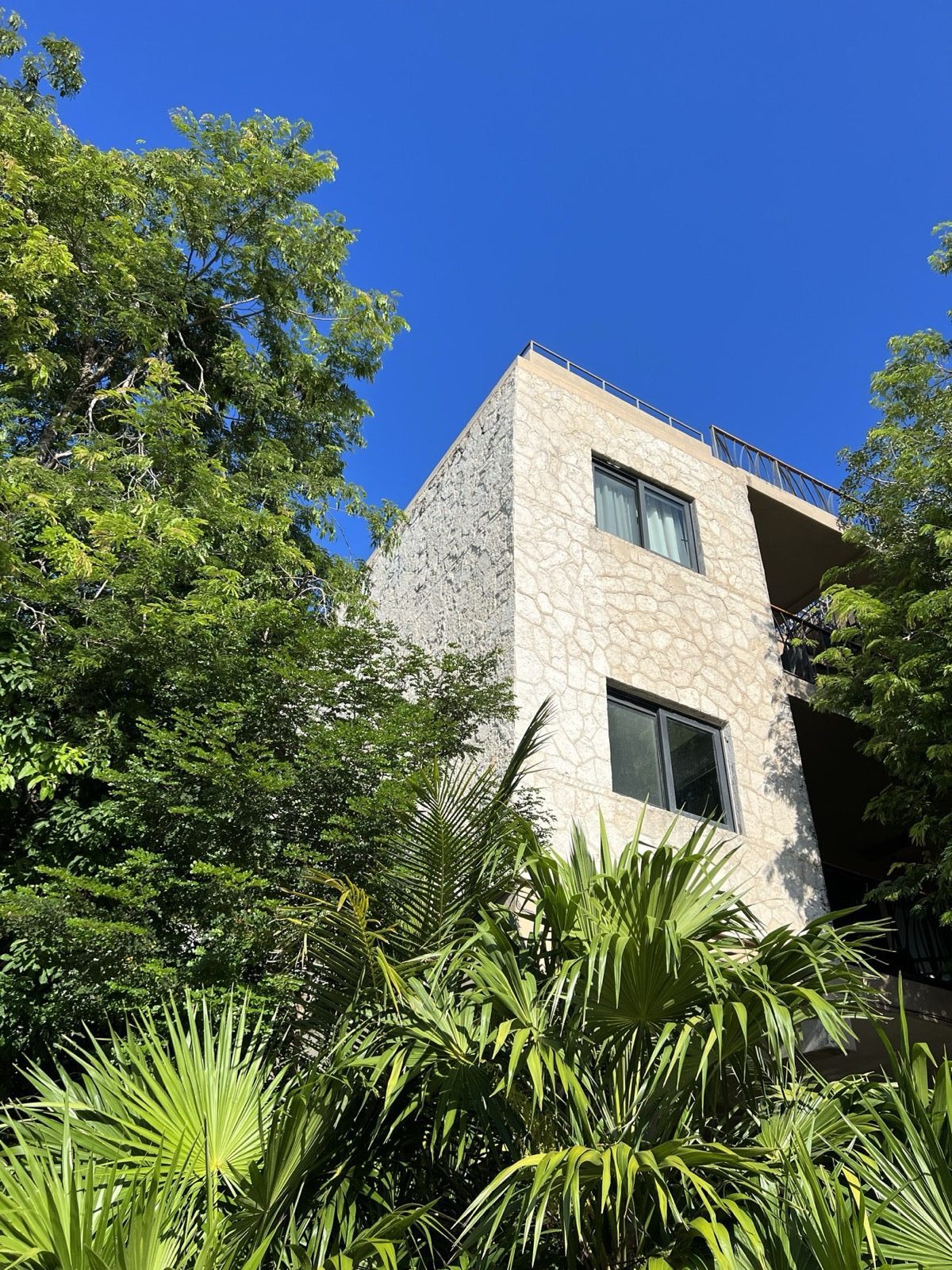
Tulum’s average short-term rental occupancy sits at 44%. That number is accurate. It is also almost completely meaningless.
The 44% is a market-wide average across more than 8,000 active Airbnb listings and over 13,000 tracked vacation rental units. It includes one-bedroom lock-off condos in Region 15 competing at $90 per night. It includes unmanaged apartments in La Veleta with phone photos and no dynamic pricing. It includes properties that haven’t updated their listing copy since 2023.
It also includes professionally operated villas that cleared 90%+ occupancy during high season and maintained 60% through shoulder months — at nightly rates ten times the market average.
These are not variations within the same market. They are two separate markets sharing a geography.
How Tulum got here
The mechanics of oversupply in Tulum are straightforward. Between 2020 and 2025, development outpaced demand infrastructure by a wide margin. The post-pandemic real estate wave brought a flood of new condo inventory — primarily one- and two-bedroom lock-off units designed from the start as Airbnb investments. Developers sold them with projected yields of 12–15%. The buildings went up. The listings went live. And the tourists did not multiply at the same rate.
By early 2026, the AMPI (Mexico’s national realtors’ association) estimates that current inventory could take three to four years to absorb at prevailing sales rates. The condo segment specifically has seen price corrections of 10–15% from 2024 peaks. Rental yields for generic condos have compressed to the point where many owners are barely covering their operating expenses.
The new Tulum International Airport was supposed to be the catalyst. It has increased arrivals — direct flights from New York and other U.S. hubs now bypass the two-hour drive from Cancún. But the airport has benefited the hotel sector disproportionately. Hotels in Tulum are projecting 90% occupancy through early 2026. Airbnbs as a category are at 43%. The gap is not about demand. It is about which accommodations the arriving travelers trust enough to book.
That trust deficit is compounded by environmental factors that hotels manage more effectively than standalone rentals. Sargassum — the seasonal seaweed that blankets Caribbean beaches during summer months — is a persistent concern for Tulum visitors. Hotels coordinate daily beach cleaning crews. Most standalone Airbnbs do not. For a traveler deciding between a hotel and an unmanaged condo during sargassum season, the calculus is obvious. Properties in the upper tier mitigate this by setting accurate seasonal expectations in listing copy, adjusting rates during peak sargassum windows, and coordinating private beach maintenance where access permits. Properties in the lower tier simply lose the booking.
The geography of the split
The two-speed dynamic maps directly onto Tulum’s neighborhoods.
Aldea Zamá remains the most stable rental submarket. Established infrastructure, walkability, proximity to restaurants and cenotes, and a critical mass of quality listings mean this neighborhood functions as its own micro-market. Properties here with professional management and strong review histories maintain occupancy rates well above the market average. It is not immune to compression, but it has a floor that newer developments do not.
La Veleta is the mixed case. Dense condo development has created a competitive listing environment, but the neighborhood’s proximity to Aldea Zamá and its emerging restaurant scene provide a demand base that raw frontier zones lack. Performance here is the most operator-dependent — the gap between a well-managed property and an unmanaged one is wider in La Veleta than anywhere else in Tulum.
Region 15 is where the oversupply thesis is most visible. Construction activity is intense, but infrastructure is still catching up. Power outages remain a persistent issue. Many buildings operate on septic systems rather than municipal water treatment. For travelers choosing between a hotel with a backup generator and a condo that goes dark when the grid fails, the decision is increasingly obvious. Properties in Region 15 without operational infrastructure — generator backup, reliable water systems, on-site maintenance response — face occupancy rates in the low 30s or below.
The Hotel Zone and Beach Road operate on scarcity economics. Limited buildable land, high barriers to entry, and direct ocean access mean these properties exist in a supply-constrained environment even as the broader market drowns in inventory. This is the segment where nightly rates of $1,500–$5,000 are achievable during peak season — but only for properties positioned, staged, and serviced at a hospitality standard.
The economics of the split
The neighborhood breakdown describes where the two speeds operate. The more useful question for investors is why certain properties escape the 44% average — and the answer is almost entirely financial, not physical.
Consider two properties in Aldea Zamá, both 4-bedroom villas, both built in 2022, both with pools. One operates at 75% annual occupancy with an ADR of $650 and gross annual revenue above $175,000. The other sits at 38% occupancy with an ADR of $280 and grosses under $40,000. Same neighborhood. Same asset class. Same year of construction.
The difference is the operating cost structure behind each one.
The first property runs the full coastal OpEx stack: $400+/month in climate control whether occupied or not, weekly pool chemistry, monthly HVAC servicing, professional photography refreshed twice per year, dynamic pricing recalibrated weekly against event calendars, a concierge layer that converts single bookings into five-star reviews and repeat guests. That infrastructure costs money — roughly 45–50% of gross revenue. But it produces revenue that justifies the cost.
The second property runs on a spreadsheet. Static pricing set at acquisition. Phone photos from move-in day. A local handyman called when something breaks. No pricing adjustment for Zamna, no rate floor during sargassum, no re-staging after the first year of guest wear. Operating costs are lower in absolute terms — maybe 25% of gross revenue. But 25% of $40,000 is $10,000. And 50% of $175,000 is $87,500. The owner spending more on operations is netting $87,500. The owner spending less is netting $30,000 — on the same asset, in the same location.
That is the two-speed market expressed in dollars. The properties in the upper tier don’t just charge more. They spend more. And the spending is what produces the charging power.
A large share of that spend is front-loaded into the interior itself, because the interior is what the guest evaluates before anything else in the operation becomes visible. We break down which design decisions actually move a Tulum villa’s occupancy — palette, lighting, scale and staging — judged by how the property reads in listing photography rather than by how it feels to stand in.
The gap between 44% and 73% occupancy is not theoretical. Model it with our underwriting tool — toggle between Conservative and Optimized to see the spread.
The foreign investor multiplier
Tulum’s ownership profile amplifies this dynamic. A significant portion of the villa and condo inventory is owned by foreign investors — primarily American, Canadian, and European buyers who purchased through the fideicomiso (bank trust) structure required for foreigners in Mexico’s restricted coastal zone.
For these owners, the operational challenge is structural. The asset requires a physical presence that the owner, by definition, cannot provide. Guest check-ins happen at 3 PM on a Tuesday in the Riviera Maya. The AC fails during a holiday weekend. A tropical storm requires the property to be secured within hours. The pool chemistry drifts because nobody checked it for two weeks.
Every one of these events is a decision point. The owner in New York or Toronto or London cannot make these decisions in real time. The question is whether someone on the ground is making them — and whether that someone has the operational infrastructure, the vendor relationships, and the financial alignment to make them correctly.
In an oversupplied market, the penalty for operational absence is not just lost revenue. It is listing degradation — poor reviews, stale photos, deferred maintenance visible in the images — that compounds over time and pushes the property deeper into the low-occupancy tier. The 44% average isn’t a number that properties fall to. It is a number that properties get trapped in when the operational layer fails.
What the data is actually telling investors
The market-wide numbers mask a structural bifurcation that standard data platforms don’t surface.
Entry-level properties — the bottom 25% of Tulum’s listings — average 14% occupancy. At that rate, a property isn’t generating income. It is generating carrying costs. These are functionally non-performing assets, and the 2026 data from Quintana Roo’s RETUR-Q registry suggests that regulatory enforcement (fines up to 100,000 pesos for unregistered listings) will thin this segment further, concentrating remaining demand toward compliant, professionally operated properties.
One-bedroom condos make up 55% of Tulum’s Airbnb inventory. They compete in the $90–$200 per night range where the price war is most intense and the margins are thinnest. This is the segment that defines the 44% average — and it is the segment that has the least capacity to invest in the operational infrastructure required to escape it.
The villa segment operates on different math entirely. Supply is structurally limited — you cannot flood a market with new villas the way you can with condo towers. Demand from high-net-worth travelers has grown since the airport opened direct U.S. service. And the yield gap we documented across our three markets manifests more dramatically in Tulum than anywhere else: in Miami and Houston, the gap between operational tiers is measured in percentage points. In Tulum, it is measured in multiples. A well-operated villa doesn’t earn 20% more than a poorly operated one. It earns four to five times more.
That is not a performance variance. It is a category separation.
Tulum is not the only Mexican market where operator quality — not the underlying asset — determines the return. Los Cabos operates on a different kind of bifurcation: not top-tier versus bottom-tier, but peak versus shoulder, where most of the annual return differential between good and average operators shows up in June through September, not in the October–May peak.
The 44% is a sorting mechanism
Tulum does not have an occupancy problem. It has an inventory quality problem. The demand is there. The question is whether the asset — and the operation behind it — is positioned to capture it.
Every month of deferred maintenance, every season of static pricing, every quarter without updated photography pushes a property further into the lower tier — where the competition is fiercest, the margins are thinnest, and the path back gets longer. The market is actively bifurcating. The middle is dissolving.
For investors holding Tulum real estate, the 44% average is not a market forecast. It is a diagnostic. The number your property operates at — and the number it will operate at next year — is a direct reflection of the operational infrastructure behind it. Not the location. Not the finishes. Not the purchase price.
The operation.
Which is why, in a market this bifurcated, Tulum property management stops being a vendor selection and becomes the investment thesis itself.