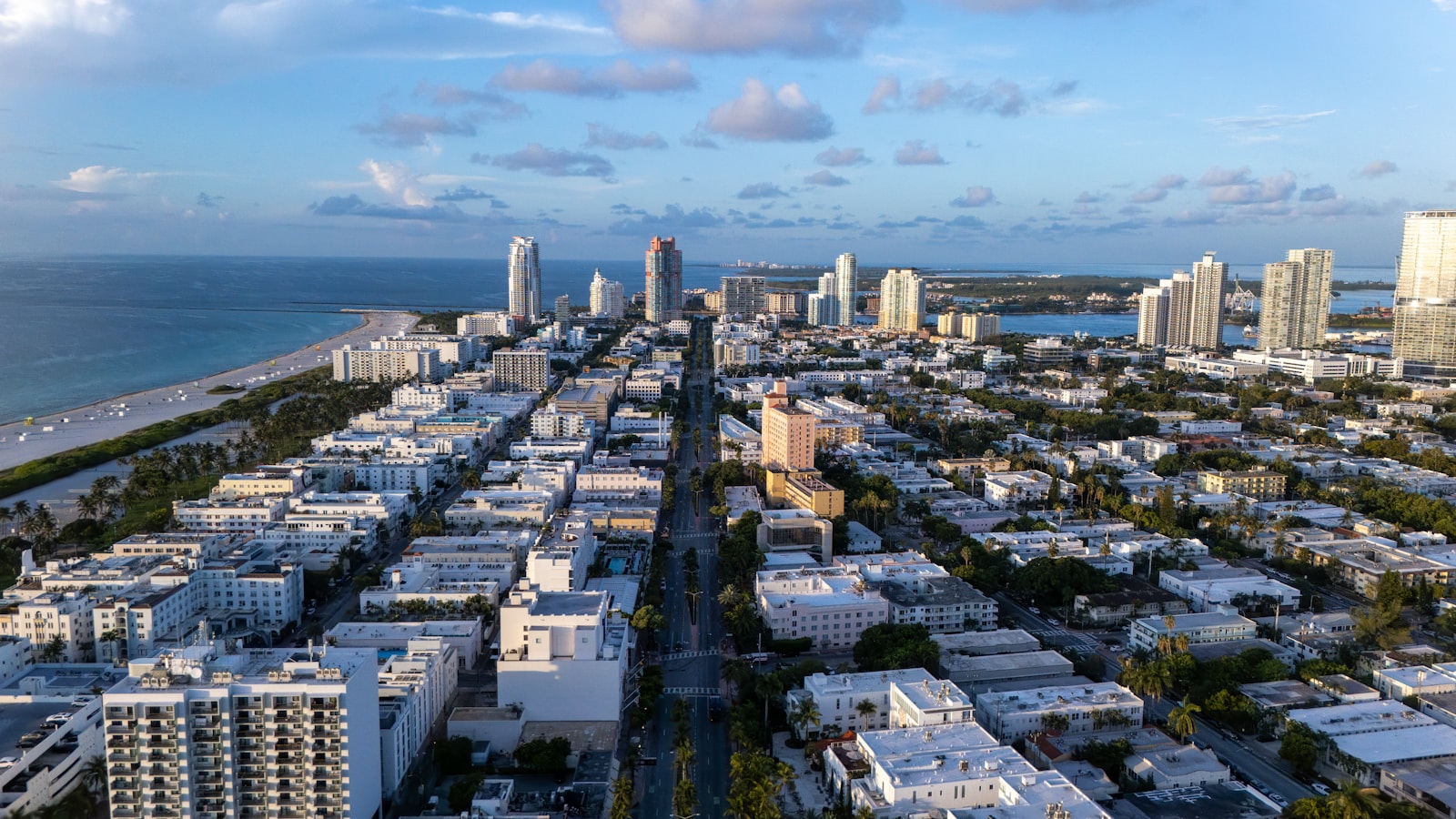
Since 2023, Downtown Miami has been absorbing something the short-term rental market had not seen at this density: entire residential towers engineered, from the ground up, to be let nightly. The Elser Hotel & Residences opened with 646 furnished residences at 398 NE 5th Street. Natiivo Miami — the same 601 NE 1st Avenue tower now also marketed as Gale Hotel & Residences — delivered roughly 448 short-term-rental condos in 2024 under an Airbnb partnership. District 225, the newest of the three at 225 North Miami Avenue, brought another 343 units online as it completed construction, sold out before delivery, with the majority of its buyers reported to come from Latin America. Each is, in practice, a single product wearing hundreds of identical faces — same floor plates, same developer furniture package, same listing photography, same amenity deck.
That homogeneity is the story. A neighborhood can absorb new short-term rental supply when it arrives scattered across different buildings, layouts, and owners. It struggles to absorb supply that arrives pre-cloned by the hundred inside one address, all of it pointed at the same demand pool and priced by the same automated tools. The result in pockets of Brickell and Downtown has been intense, localized yield compression — not because Miami ran out of guests, but because a single building can quietly compete with itself.
Why Demand Is Up but Building Rates Are Down
The compression is local, not citywide, and that distinction is the whole point. At the metro level, Miami’s fundamentals have held up even as inventory climbed: one industry dataset put short-term rental supply growth across Miami near 77% year over year through early 2026, with nightly rates still trending upward — a sign that traveler demand was broadly keeping pace with new listings. Across the U.S., average occupancy did soften from roughly 57% in 2024 toward the low-50s in 2025 as supply expanded, but rate held and revenue per available rental kept growing in many markets.
So the macro picture is not collapse. The problem is concentration. When 300 furnished units in one tower share a floor plan, a furniture kit, and a guest-facing amenity set, the only variable a booking guest can see on the search page is price. And when the comparison set that every owner’s pricing tool reads is, overwhelmingly, the other units in the same building, a single owner discounting to fill a calendar drags the visible comp set down for everyone behind them. That is a building-specific phenomenon. A scattered-inventory neighborhood does not behave this way; a several-hundred-unit monoculture does.
The Cap Rate Trap
The trap is that a tower unit is underwritten on market-level performance but operated inside a building-level micro-market. A developer’s pro-forma, or a third-party revenue estimate handed to a prospective buyer, draws its comparables from the broader Miami short-term rental market — a healthier, more varied pool of properties spread across the city. The unit the buyer actually closes on does not compete in that pool. It competes against the 340 or 640 units directly above and below it, which are visually indistinguishable from it.
Uniform asset distribution is what breaks the model. In a conventional building, no two short-term rental units are quite alike — different owners renovate to different standards, stage differently, photograph differently, and price to different cost bases. That variation is what lets a well-run unit command a premium and hold occupancy without chasing rate. In a purpose-built tower delivered furnished and identical, that variation is engineered out at handover. Every owner starts from the same product, which means the pro-forma’s assumed ability to “outperform the market” has nothing to act on. The cap rate that looked defensible against city comps compresses against building comps the moment the building fills.
The Algorithmic Deflationary Spiral
A deflationary spiral inside a tower forms when automated pricing reads a comp set that is mostly the building itself, and the owners feeding that comp set are under pressure to cover fixed costs that do not move. Most dynamic-pricing engines price reactively: they observe what comparable, available units nearby are charging and adjust toward the cluster. Inside a homogenous tower, “comparable units nearby” means the floors above and below. One owner cuts rate to avoid a vacant week; the engines covering neighboring units register a softer comp set and trim; those trims become the next data point; and the building’s effective rate floor walks downward without any single owner deciding it should.
What turns a dip into a spiral is the cost side. These owners are not pricing from a position of patience. Miami-Dade’s median condo association fee reached roughly $900 a month in 2024, up about 59% from 2019, and Brickell dues commonly run near $0.65 per square foot before considering anything bespoke. The insurance component alone now adds an estimated $350 to $400 per unit per month in many Miami-Dade high-rises in the wake of stricter post-Surfside underwriting, and special assessments for structural recertification have become routine under Florida’s tightened condo-reform reserve laws. An owner staring at a four-figure monthly carry has a powerful incentive to take a soft booking at almost any rate rather than hold for a number the calendar may not deliver. Multiply that incentive across hundreds of identically-positioned owners and the algorithm has all the fuel it needs.
Breaking out of the loop does not happen on the price axis, because the price axis is exactly where the building has been engineered to commoditize the unit. It happens by giving the listing — and the stay — an attribute the algorithm cannot read off a comp and the building cannot reproduce at handover. That means moving the competition off rate entirely.
From Management to Hospitality Branding
Differentiation inside a homogenous tower is a product problem before it is an operations problem, and it is solved by making one unit demonstrably a different stay from the 400 around it. Two levers do most of the work, and neither is dynamic pricing.
The first is interior asset hardening: deliberately taking the unit beyond the developer-standard furniture package so it photographs differently, reviews differently, and survives nightly turnover better than its neighbors. The developer kit is built to a price and replicated by the hundred; an owner who replaces the generic staging with a distinct, durable, design-led interior breaks the visual tie on the search page — the only place where a guest can tell two identical floor plans apart — and reduces the wear-and-replacement drag that erodes margin in high-frequency rental. The unit stops reading as “another Elser studio” and starts reading as a specific place a guest chose on purpose.
The second is a private arrival and stay layer that sits above the building’s shared front-desk experience. In a tower where every guest moves through the same lobby and the same amenity deck, the operator who controls a distinct, branded check-in, guest-communication, and in-stay service standard creates a hospitality identity the building itself does not provide. The shared amenities become a backdrop rather than the product; the product becomes the experience the operator wraps around them.
This is the shift from property management to hospitality branding, and it is the practical answer to unit homogeneity. Management treats the unit as a line item to keep occupied. Hospitality branding treats it as a named place with a point of view, a service standard, and a reason to be booked at a held rate while the building’s commodity inventory discounts around it. Virestia’s work in Miami is built on that distinction: drawing on roughly nine years of operating short-term rentals and several hundred guest reviews, the emphasis is on a defined guest experience and an interior that earns its rate, rather than on chasing the building’s pricing floor downward.
Underwriting a Tower Unit Now
For the kind of owner these towers were sold to — absentee, often international, holding the unit as a portfolio asset rather than a residence — the structural risk is precisely the inability to be on-site and differentiate by hand. District 225’s buyer pool was reported as roughly half Latin American, and Natiivo and The Elser drew comparable international and out-of-state interest. These are buildings full of owners who cannot personally stage a unit, meet a guest, or notice that the developer sofa has aged into every other photo in the building. The differentiation that holds rate has to be delivered operationally, by someone on the ground, or it does not get delivered at all.
That is the honest underwriting question for a Brickell or Downtown tower unit in this cycle. The building’s furnished, ready-to-let proposition is real, and so is its commoditizing effect on rate. The unit will perform at the building’s compressed floor by default, and above it only by intent. An owner deciding whether a given tower unit pencils should be underwriting not the developer’s market-level projection but the cost and feasibility of operating the unit as a distinct hospitality product inside a homogenous structure — because that, not the floor plan, is what separates the cap rate on paper from the cap rate in practice.
Virestia does not publish revenue projections; performance inside these buildings depends too heavily on the specific unit, its position, and how it is operated to responsibly forecast. What we can do is assess a specific tower unit against the building’s competitive reality and propose how it would be positioned to hold rate rather than feed the spiral. The market figures cited here are drawn from third-party sources as of mid-2026 and describe area-level conditions rather than the performance of any individual building or unit. Owners weighing a purpose-built STR tower unit in Brickell or Downtown can request a management proposal for a unit-specific view.